

How the integration of space and technology helps create a healthier workplace
Offices are primarily designed for human needs and experiences. The essence of a workplace lies in catering to the demands and experiences of the user — not the environment. Any optimization or maintenance effort should align with the user's needs; overlooking them deviates from the building's core purpose. In every phase, whether construction, renovation, or modification, the users of the facility must be the foremost consideration.
And there's no denying it — new, innovative workplaces across the world are challenging our understanding of what the office can do and redefining contemporary work in the process. An emergent design philosophy, called human-centered design, is creating workplaces that can accommodate the fluctuating needs of individuals, teams, and entire organizations on a day-to-day basis, doing away with homogenous, unchanging offices. It does this by serving as the link between the four projects contained in each office building project: construction, technology, human, and feedback.
Inspired by precedents set in retail, leisure, and hospitality — which use feedback systems to create responsive environments — the human-centered approach applies User Experience (UX) methodologies to a range of contexts, including the workplace. By equipping buildings with the correct technology foundation that can intelligently monitor and adapt to meet the workforce's diverse expectations, human-centered design ensures that the users of a building, and therefore the organization itself, can thrive every day, no matter the context.

It's no coincidence that this design philosophy is gaining momentum right as hybrid work becomes the predominant paradigm for offices. In a world where workspace occupancy often swings between 20% and 90% over the course of a single week, the office should be equipped to suit many different uses. To achieve this, we need to know the "how" of delivering smart spaces — and in UX, we have a process that can support the engineering design effort by:
- Getting everyone to talk the same language
- Providing a clear brief on what's technically required
- Determining how success will be measured
- Describing how the building, space, and workflows will operate
- Setting up how the building can adapt to future needs
- Proving it operates sustainably, providing a healthy environment
The reinvention of the workplace as we know it necessitates a commensurate workspace evolution: employees, now recast as the discerning user, need compelling reasons to come into the office beyond compulsory attendance. The office must therefore appeal both to each individual's unique multisensory preferences and to the diverse needs of the entire organization, to ensure the office remains a valued hub for collaboration. Rather than fixating on traditional metrics like capacity and flow rate, designers must consider what inspires those who use their designs every day. Without this insight, friction between the workflow and workplace becomes a source of daily distress, preventing the optimization of critical outcomes such as retention, recruitment, productivity, and workplace culture.
Before going any further, it's worth pointing out that a truly human-centered design is reliant on a smart building, which is not the same as a smart workplace. Smart technologies like space-booking systems, for instance, don't require a building that can automatically adjust the temperature of a room according to whether or not that room is being used. Though smart workplaces are certainly a step in the right direction, their full potential can't be realized until their virtual technologies have been fully integrated with the physical space's Mechanical, Engineering, and Plumbing (MEP) systems. When equipped with a smart building technology foundation, the same space-booking system used in a smart workplace can automatically adjust a room's temperature, ventilation, and lighting in anticipation of its scheduled occupancy and the stated preferences of its occupants. The combination of smart building IT and OT technologies with human-centered design gives way to a fully responsive building, which facilitates communication between workers and activates those communications to make helpful, real-time adjustments.
This alignment is never reached in the blink of an eye. Before a fully responsive building can be designed, workers and leaders must be directly consulted to evaluate how a space should be designed to suit the very specific needs of the people who will use it. Through UX research, factors like occupancy levels, personal health, and workstyle preferences are studied to provide a sense of clarity that might not otherwise be reached.
What might that look like? Envision beginning your day with an app that not only updates you about your meetings and the traffic, but also indicates which workstation has the best sunlight or is away from noisy areas. Once you get to work, the building might greet you with your favorite tune or a motivational quote to kick-start your day. Indoor plants could be watered by sensors that detect soil dryness, ensuring a fresh atmosphere that promotes wellness. Indoor air quality could be maintained to a level that exceeds what you have at home.

Need a coffee? Your building might have already pre-ordered your preferred brew, knowing your daily routine. Elevators will predict which floor you're going to based on your schedule, and restrooms will alert janitorial staff when supplies are low or if immediate cleaning is needed. Energy management systems will ensure lights and electronics turn off in unused areas, promoting sustainability. And if you've been at your desk for too long, the building might suggest you take a walk outside, guiding you to a nearby park. The convergence of technology and infrastructure will redefine our idea of a "day at the office," turning it into a more intuitive, sustainable, and human-centric experience.
With this type of information, the organization, designers, and other stakeholders are able to settle on discrete project objectives and quantitative benchmarks they can use to measure success moving forward. This, in turn, helps prevent costly reworks that come when a design fails to account for fundamental characteristics of the workplace it was supposed to serve. But the time required for this consultation must be accounted for in project budgets from the start, if the level of design accuracy needed to avoid costly reworks is to be realized.
Paradoxically, the most impactful feature of human-centered design is that it's never truly finished. While the space may be formally complete, the feedback process should always continue. This design philosophy — known as "future-proofing" — together with the continuous "building tuning" gained from ongoing data analysis, ensures the building remains dynamic enough to adjust to the evolving needs of an organization's workforce.
As building system data, building performance data, and personal user data (collected via surveys) are continuously, if less intensively, monitored, leadership is able to deduce whether the design is achieving its original objectives — and if not, what can be done to optimize its results.
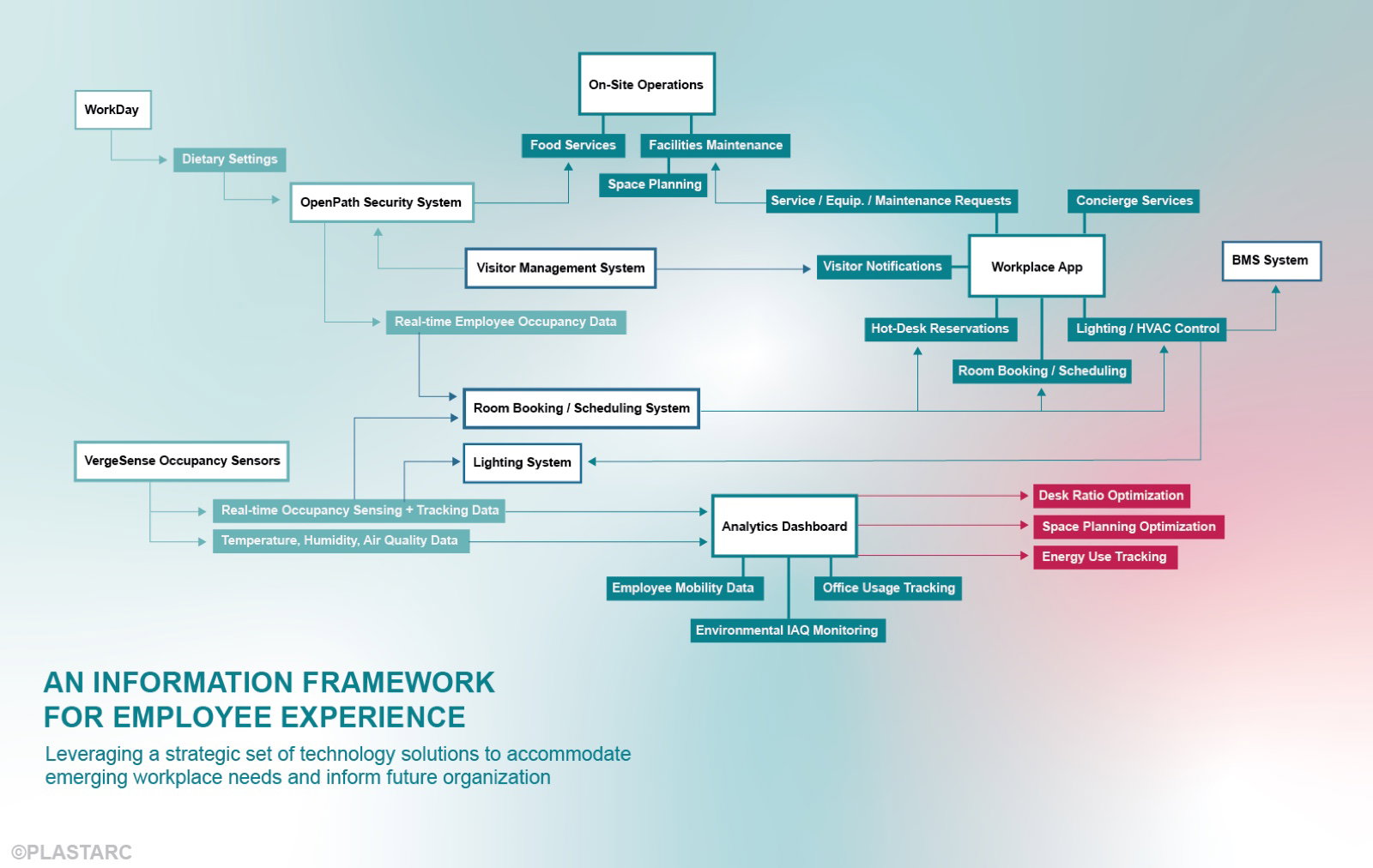
Human-centered design is intended to be responsive, not prescriptive — and as such, smart buildings intentionally leave plenty of room for adjustment. This marks a major paradigm shift, and relevant stakeholders are bound to face a few major obstacles as they move toward this sweeping and urgent evolution. Most notably, a complete integration of all building components demands that everyone contributing to the design and construction process — designers, engineers, and contractors — implement their own thoughtful communication practices.
In an industry that has long been made up of stakeholders who know how to work alongside each other but rarely see reason to work with each other, this is nothing short of a sea change.
A clear precedent has already been set. The WELL Building Standard and the International Living Future Institute both offer frameworks that demonstrate how the alignment of diverse objectives in service of a holistic design can give way to a fully responsive building, when engaged early in the design process. The coalition of disparate stakeholders, once thought impossible, is aptly captured in the integration of all building components.
In a responsive workplace, workers are more able to enjoy their surroundings and focus on the task at hand. We see this system seamlessly align worker wellness with other key organizational priorities time and time again: in one example, the optimization of HVAC systems and lighting according to workers' preferences also reduces operating costs and minimizes carbon emissions.

A basic but previously unattainable virtue is suddenly within reach, thanks to smart building technologies: that a room's electrical amenities should cater to the people using them. Not only whether people are present, but how many, where they're sitting, what the meeting function is, and what environmental settings they prefer. The room can adjust based on the actual number of attendees, real-time indoor air quality sensor data, or catering needs — and even suggest a different meeting location if equipment faults are detected.
It's worth noting that countless international companies — including Google, Amazon, and Bloomberg — have already implemented human-centered design in their headquarters.
Deloitte's Amsterdam offices, for instance, use a smartphone app to help employees find parking spaces, desks, and even colleagues within the building. Sensors in the building track usage patterns and adjust lighting, temperature, and other factors to optimize energy use and enhance the working experience. The building, known as The Edge, has been fondly referred to as "the smartest building in the world" — and fosters a sense of discovery by preventing employees from falling into a rigid routine.
By activating human-centered design techniques, forward-thinking responsive offices like these are inspiring change across industries. While these innovative organizations are integrating technology and space to serve their workers' needs, those that delay their evolution are having a harder time attracting and retaining talent. The financial and logistical barriers may seem intimidating, but human-centered design — both its process and its product — is undoubtedly the new gold standard.
Meet the authors
Brian Coogan, Director, Digital Services | ETHOS ENGINEERING
As a dedicated digital transformationist, Brian combines his passion for digital technologies with his experience, studies, and learnings in UX and digital innovation to help organizations invest in the right technology. As Director of Digital Services at Ethos Engineering, he works to deliver complex, integrated, and innovative ecosystems that enable data-driven decisions within the built environment.
Melissa Marsh, Founder and CEO | PLASTARC
Melissa Marsh is the Founder and CEO of PLASTARC, a social-science-based workplace consultancy. Melissa combines quantitative and qualitative social science research with architectural expertise. She advocates for evidence-based workplace interventions that make the built environment more people-centric, promoting both wellness and business success.